What is a transcript? Audio and video transcripts explained
A transcript is a written record of what was said in a recording: a meeting, interview, lecture, podcast or video. A good one tells you not only the words but who said them and when. Looking for an academic transcript, the record of your grades? That's a different document, issued by your school's registrar.
By VexaScribe Editorial · Published July 3, 2026 · Rewritten November 19, 2026
Transcript and transcription
The word comes from the Latin transcribere, "to write across" or copy out. Transcription is the act of writing speech down and the transcript is the result, though in everyday use the two mean the same thing. Courts have their own kind: the verbatim record of a hearing, made by a court reporter.
What a transcript contains
Three things, in order of how basic they are:
- The text: the words that were spoken.
- Speakers: who said each part, as names or labels such as Speaker 1.
- Timestamps: when each part was said, so you can find it in the recording.
The same 20 seconds of a webinar, three ways:
Welcome, everyone, and thanks for joining today's webinar. Thanks, Priya.
I'll start with the setup checklist. What trips people up the most?
Permissions. Invite your admins first, then everyone else.[00:00:00] Welcome, everyone, and thanks for joining today's webinar.
[00:00:10] Thanks, Priya. I'll start with the setup checklist.
[00:00:17] What trips people up the most?
[00:00:20] Permissions. Invite your admins first, then everyone else.[00:00:00] Priya: Welcome, everyone, and thanks for joining today's webinar.
[00:00:10] Marcus: Thanks, Priya. I'll start with the setup checklist.
[00:00:17] Priya: What trips people up the most?
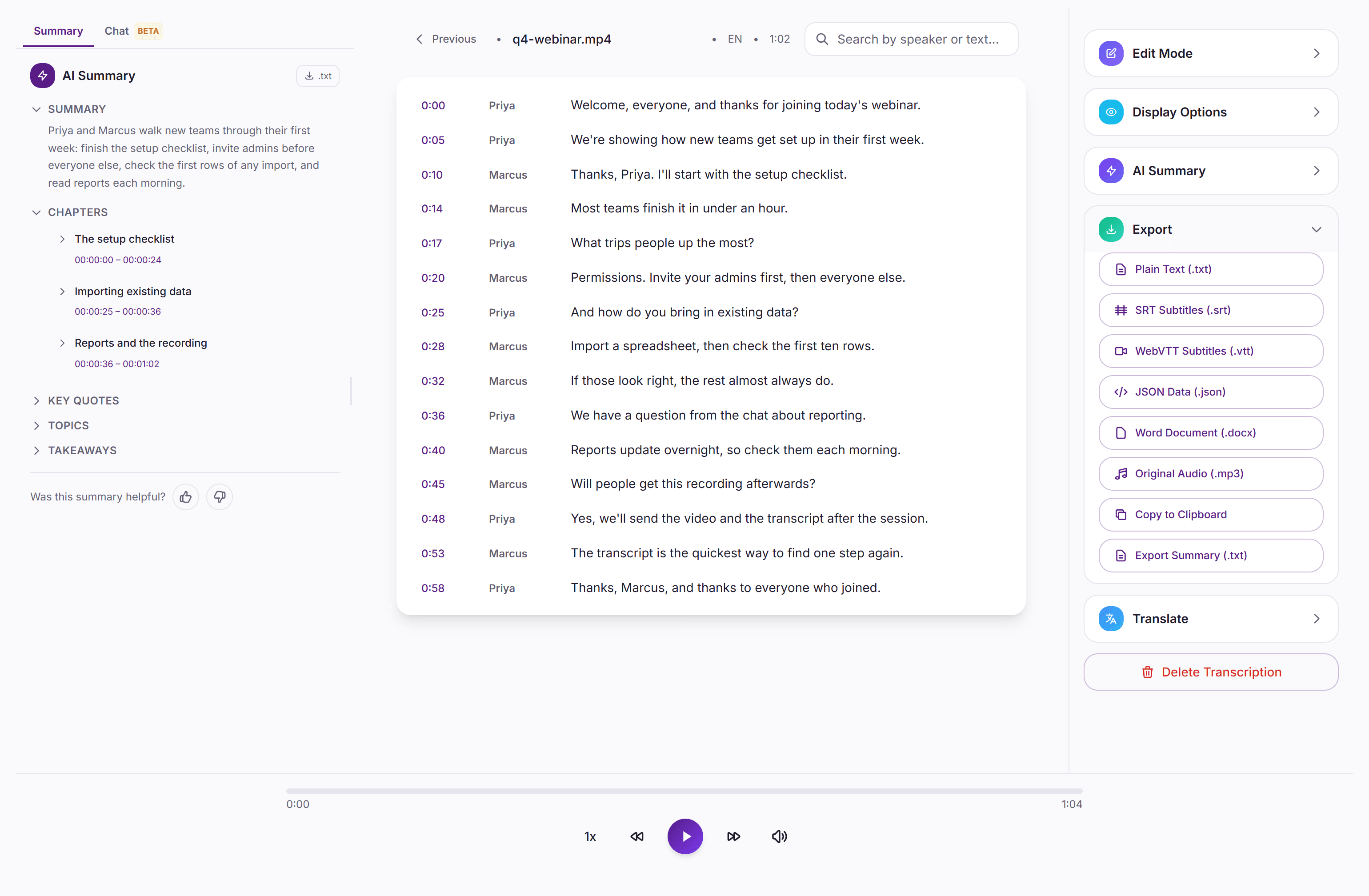
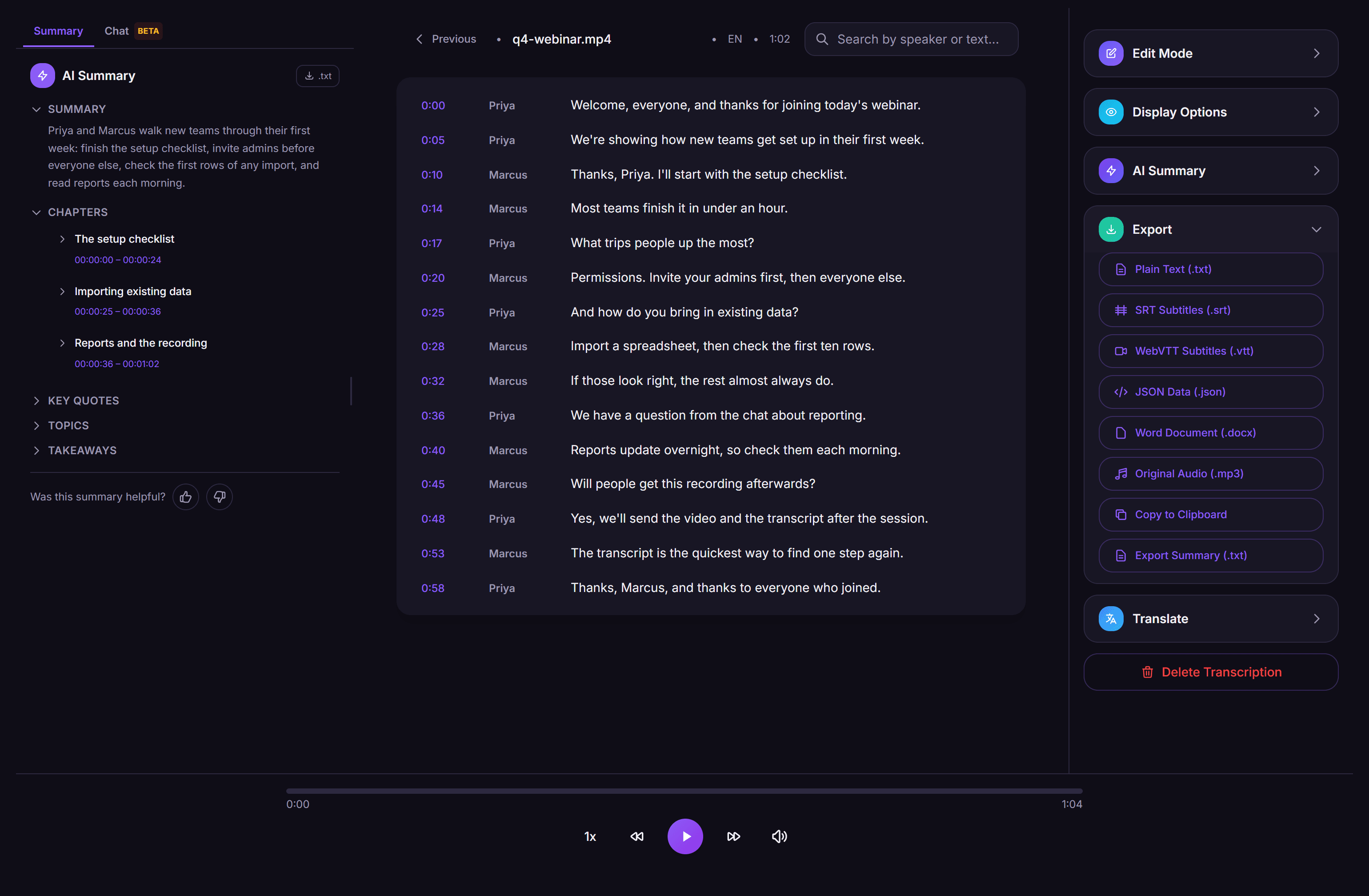
[00:00:20] Marcus: Permissions. Invite your admins first, then everyone else.Plain text is enough to read or paste into a document. Timestamps let you find a passage in the recording. With more than one person talking, you need speakers too.
This is what the same recording looks like as a transcript in VexaScribe:
Types of transcript
Verbatim keeps every word as spoken, um and uh included, for research and legal work. Intelligent verbatim keeps the meaning and removes the filler, the usual choice for meetings and interviews. Edited transcripts are tidied into prose for publishing. More in transcript formatting.
Transcript vs subtitles, captions, notes and minutes
| What it is | Timing | Length | |
|---|---|---|---|
| Transcript | The full text of what was said, to read on its own | Optional | As long as the recording |
| Captions | Same-language text on screen, with sounds like [music] for viewers who can't hear | Yes, every cue | Short cues |
| Subtitles | On-screen text for viewers who can hear, often translated | Yes, every cue | Short cues |
| Notes | The points someone chose to write down | Rarely | Short |
| Minutes | The formal record of a meeting: decisions, votes, actions | No | Short |
| Summary | A condensed version of the content | Sometimes, per chapter | A fraction of the source |
Captions and subtitles are made from the same words as a transcript, cut into short timed pieces that appear on screen; see closed captioning and SRT files. Notes, minutes and summaries are shorter documents someone writes from the content.
How transcripts are made
By hand, someone listens and types, which takes several times the length of the recording; court reporters use stenotype machines to keep up live. Today most transcripts start with speech recognition, which produces a draft with timestamps and speakers in minutes, and a person then checks it against the audio. Names, numbers and people talking over each other are where mistakes collect.
What you can do with one
A transcript turns a recording you would have to replay into text you can work with:
- Find and quote. Search for a word and jump to the moment it was said.
- Summarise. Get an overview, chapters, key quotes and action items; see transcript to summary.
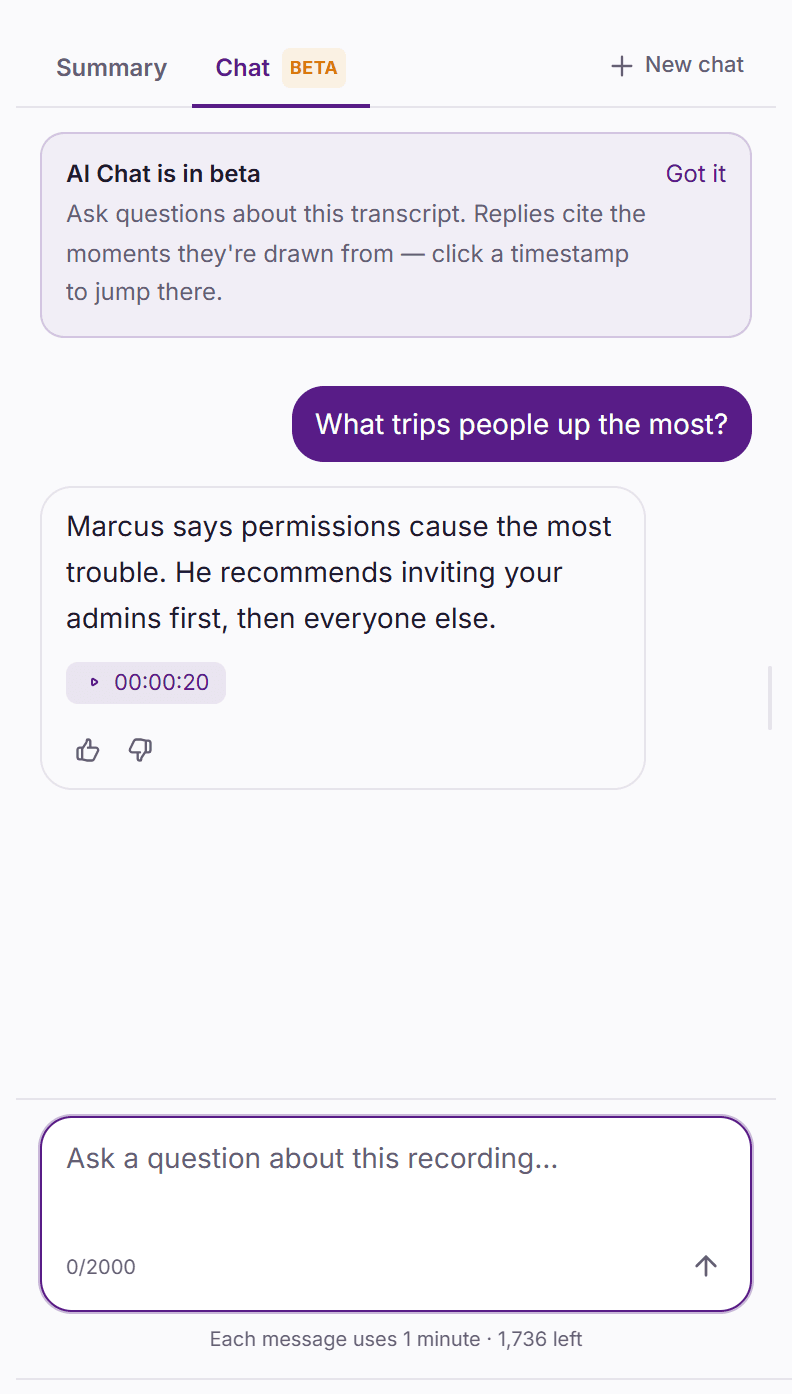
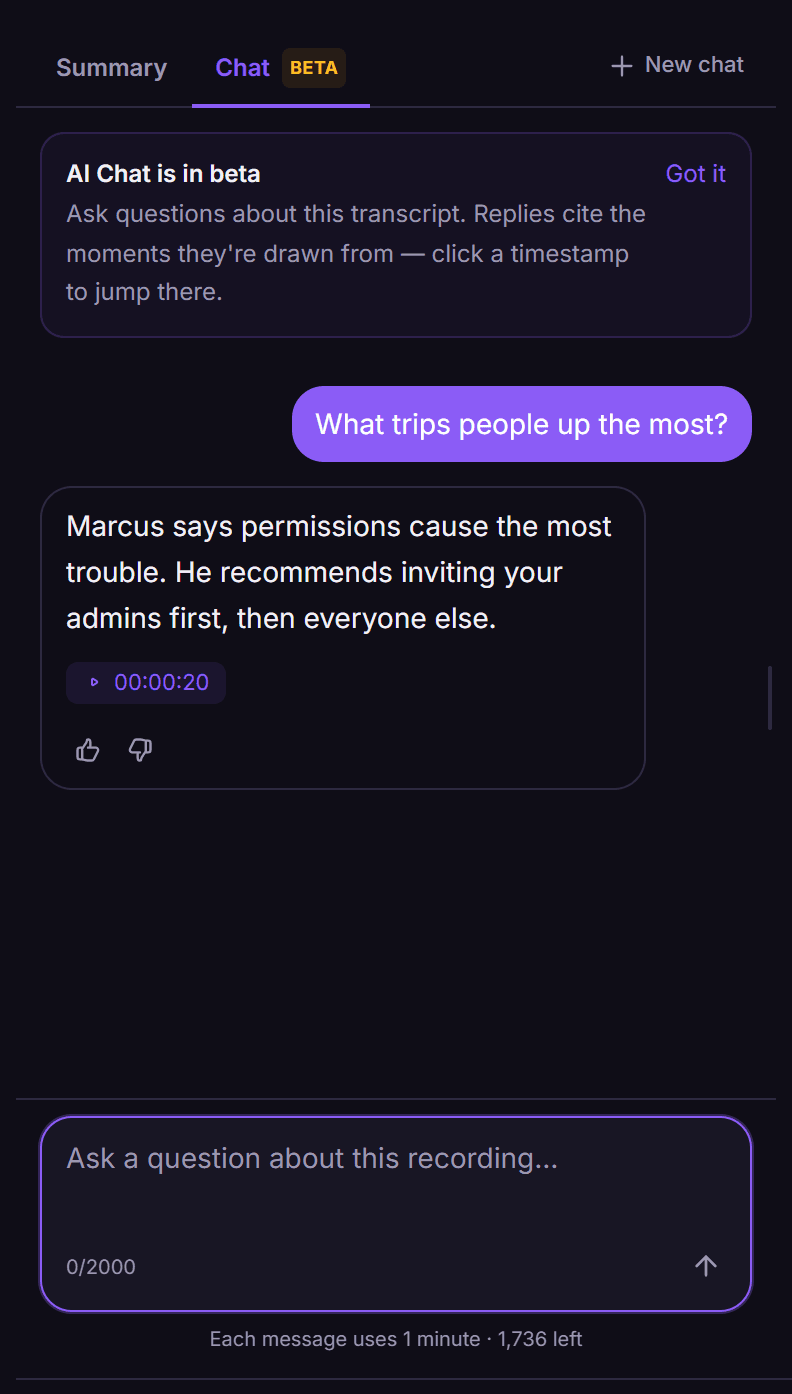
- Ask questions. "What did we decide about the budget?", with an answer that points to where it was said.
- Make subtitles. Cut the same text into timed captions for a video with the SRT generator.
- Translate. Share the content in another language; see transcribe and translate.
- Make it accessible. W3C's WCAG 2.1 guideline 1.2.1 asks for a text alternative, such as a transcript, for prerecorded audio-only content.
Try it on your own recording
Upload audio or video as it is. You get the transcript with speakers and timestamps, can fix words while the audio plays, and export Word, TXT, SRT, VTT or JSON.
Drop your audio file here
or click to browse
Audio: MP3 · WAV · M4A · AAC · OGG · OPUS · WMA · FLAC · AMR · AIFF
Video: MP4 · MOV · MPEG · WMV · AVI · MKV · WEBM · FLV · 3GP · M4V
Up to 200 MB · first 5 minutes free, no account
Sign up free for 30 minutes and files up to 5 GB, no card.
Before you share a transcript
- Names of people, places and products spelled right
- Numbers, dates and amounts checked against the audio
- "Speaker 1" and "Speaker 2" replaced with names or roles
- Filler words handled the same way throughout
- Anything you will quote heard again in the recording
Sources
Screenshots are of the real VexaScribe app with made-up example recordings. See our editorial standards.
Frequently Asked Questions
What is a transcript in simple words?
A written copy of what was said in a recording, such as a meeting, interview, lecture or video. A full transcript also shows who said each part and when. An academic transcript, the record of a student's grades, is a different document issued by a school.
What is the difference between a transcript and a transcription?
In everyday use, none: both mean the written record. Strictly, transcription is the process of writing speech down and the transcript is the finished document.
What is the difference between a transcript and captions?
A transcript is the full text, meant to be read on its own. Captions are the same words cut into short timed pieces shown on screen with the video, usually with sounds such as [music] for viewers who can't hear.
What should a transcript include?
At least the spoken words. For anything with more than one speaker, the speaker of each part, and for long recordings, timestamps so you can find a passage in the audio. Research and legal transcripts often add a header with date, participants and length.
How do I get a transcript of a recording?
Type it yourself, or upload the file to a speech-to-text tool and correct the draft. VexaScribe gives 30 free minutes when you sign up, with speakers named and timestamps, and exports to Word, TXT, SRT, VTT or JSON.